

What is biophobia?
Biophobia is a response of fear, disgust or aversion towards natural organisms, environments or situations. In the design of a garden, courtyard or workplace, it can influence what we accept and what we ask to remove. Addressing it means listening to people, assessing risks and designing conditions for coexistence, without imposing contact with animals.
A spider’s web changes the question
A web between two stems, just beyond a path, may be a detail that one person stops to observe and another would like removed immediately. Its position matters. Does it cross the walkway? Is it beside a seat? Does it remain within the planting, away from people walking past?
These differences are decisive for design. The same presence can require different responses depending on where it is and how the place is experienced. Before intervening, we need to understand which problem we are trying to solve.
This applies to a shared residential garden, a hotel entrance or an office courtyard. When we ask for nature in inhabited spaces, we need to allow for the possibility that other organisms will inhabit it too.
Biophilia, biophobia and management decisions
In research on human–nature relationships, biophobia includes negative responses such as fear and disgust. It can concern particular animals, but also environments and situations: dense vegetation, places that are difficult to navigate and unexpected encounters. Its use in this context is broader than a clinical diagnosis. Source: Soga and Evans, 2024, DOI 10.1002/pan3.10647.
Biophilia and biophobia can coexist in the same person. Someone may want a flowering garden and feel uncomfortable with the insects that visit it. This ambivalence deserves attention: dismissing it as ignorance prevents us from understanding what relationship with the place is possible.
In biophilic architecture, the presence of nature must be considered alongside uses, preferences and actual conditions. A project cannot assume that everyone will respond positively in the same way.
In 2023, Masashi Soga, Kevin Gaston, Yuya Fukano and Maldwyn Evans proposed the “vicious cycle of biophobia”: negative information or experiences may encourage aversion; aversion may lead people to avoid nature; fewer encounters may deepen disconnection and reinforce further aversion.
This is a conceptual model, not a rule that automatically describes every individual. It does, however, help us consider a possible consequence of collective decisions: removing every opportunity for an encounter may also remove opportunities to learn. Source: The vicious cycle of biophobia, 2023, DOI 10.1016/j.tree.2022.12.012.
For BIOMA, the design implication is to offer different degrees of proximity. A planted border can be observed from a path; a seat can face vegetation without being surrounded by it. These are spatial choices that respect the people using a place. They are not treatments for fear and do not guarantee its reduction.
Mowing, pruning and lighting also respond to requirements for access, use and maintenance. We cannot infer a manager’s state of mind from the appearance of a garden.
We can instead discuss the reason behind a request. “I want to see where I am stepping” is a need that can inform design. “There must not be any insects” expresses a very different expectation, one that is difficult to reconcile with an outdoor planted space.
Ecological effects also need to be described precisely. A study of urban grasslands observed an increase in plant species richness following reduced mowing. This supports the possibility of varying management across a site; it does not mean that abandoning any lawn will produce the same outcome. Initial conditions, vegetation and the way interventions are carried out all matter. Source: Less is more!, 2020, DOI 10.1016/j.baae.2019.10.008.
The useful question becomes: which areas need to support circulation or play, and which could be managed differently?
Four decisions for designing coexistence
The following criteria are BIOMA’s proposed way of approaching the issue. They need to be adapted to the place and checked with the relevant expertise.
1. Make the route clear. A recognisable path, with a width and surface appropriate to its users, allows people to move through a garden without entering the vegetation. A clear edge between the path and the planting can communicate care even where dry stems or less frequently mown areas are retained. Distances should follow actual uses: there is no universal measurement that prevents discomfort.
2. Distinguish areas by intensity of use. An everyday entrance, an outdoor eating area and a peripheral strip do not necessarily need the same treatment. Differentiated management can focus intervention where it is needed and retain habitat elements elsewhere, where compatible with the context. The approach must also be understandable to those responsible for maintenance.
3. Design for the places light does not reach. In the English sites they studied, Douglas Boyes and colleagues found lower abundances of moth caterpillars along illuminated hedgerows and grassy margins than at comparable unlit sites. The result concerns those contexts and organisms; it does not measure a uniform loss of all biodiversity. Source: Science Advances, 2021, DOI 10.1126/sciadv.abi8322.
For design, this is a reason to assess the direction, duration and distribution of light alongside safety and usability requirements. Lighting a walkway requires a different study from illuminating an entire tree canopy. Choosing warm light alone does not resolve every impact.
4. Write down how conflicts will be managed. A project should identify who receives a report, who identifies the problem and who decides on the intervention. A generic request to “tidy up” leaves too much room for incompatible interpretations: for some it means removing every leaf; for others, keeping paths clear and checking for hazards.
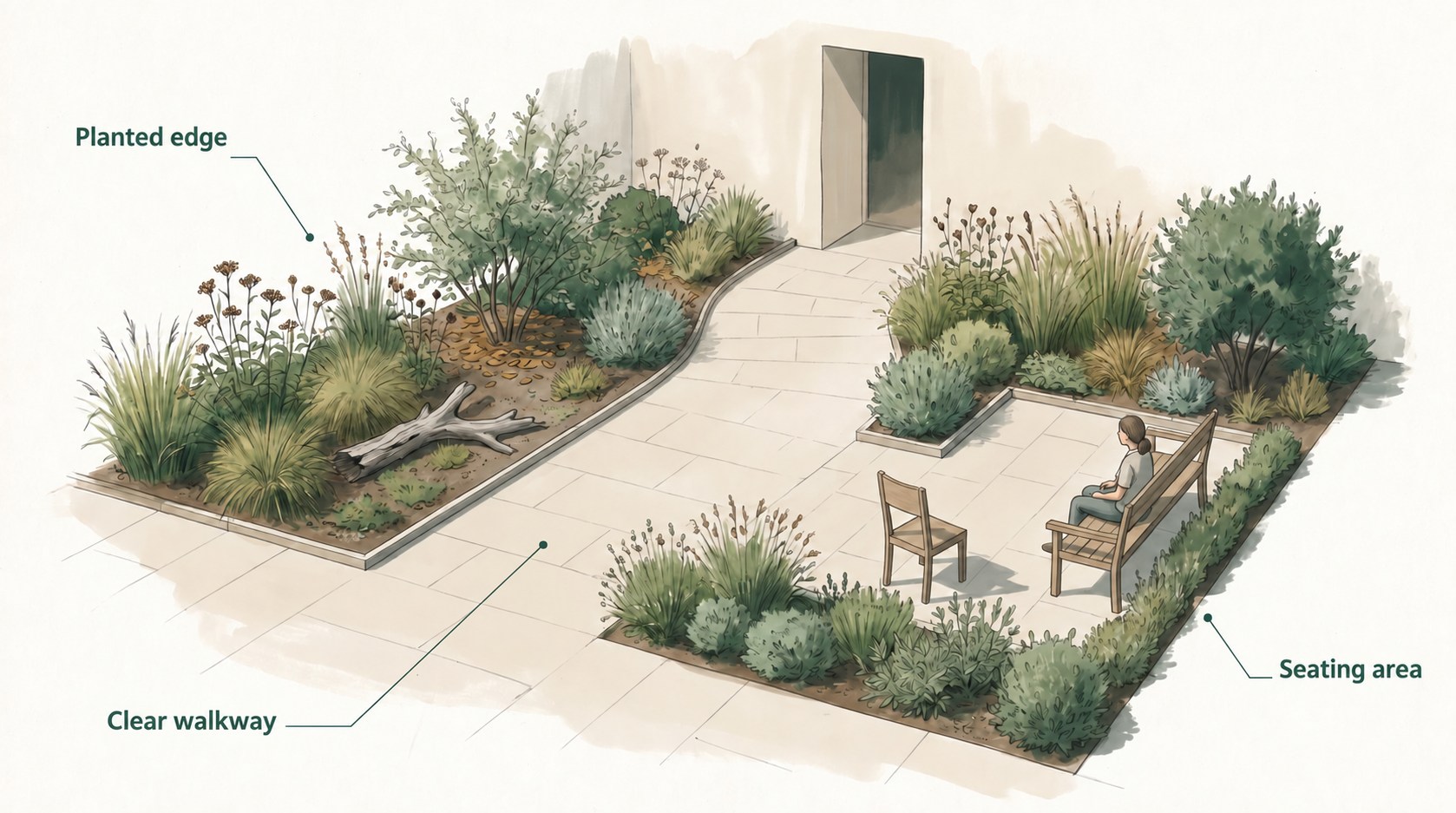
The illustration distinguishes three areas to coordinate: circulation, seating and the planted edge. The proximity of planting to seats remains a choice to discuss with users. Widths, distances and maintenance should be defined for the actual site, rather than inferred from this illustration.
Before removing anything, ask five questions
A short checklist can make discussions between the client, designer and maintenance team more precise:
- What is present? Identify the organism or condition; “insects” is too broad a category on which to base an intervention.
- What is happening? Distinguish aversion, an obstacle to using the space and a risk that can be substantiated.
- Where and when does the encounter occur? An infrequently used edge and a daily entrance raise different questions.
- Which intervention is proportionate? Consider targeted maintenance, access management or spatial changes, with specialist support where needed.
- How will we know whether it worked? Record reports, conditions of use and the need for further action. User observations do not replace ecological monitoring.
Consider, for example, an office courtyard where people report discomfort near the seating. Before replacing the entire planted bed, we need information about what is present, at what times and during which activities. If the issue concerns interference with circulation, the response may be spatial. If a specific risk emerges, it requires a competent assessment. The same initial report can lead to different decisions.
Limits are part of the design
Coexistence does not mean accepting every presence in every location. A confirmed risk or incompatibility with use requires a response. Intense fear also deserves respect: nobody should have to cross a place they experience as threatening to prove that they love nature.
The BIOMA Method brings together an understanding of people and an understanding of place. A choice needs a reason: what are we protecting, which interference are we reducing and which conditions do we want to retain?
A garden changes throughout the year. The quality of a proposal therefore also depends on who will care for it, which signals they will observe and when they will be willing to reconsider a decision.
Are you designing a space where relationships with nature lead to uncertainty or conflicting requests? Tell us about the place and what currently limits its use through BIOMA’s Contact page.
Frequently asked questions
Is biophobia always a clinical phobia?
No. In research on human–nature relationships, the term also includes fear, disgust and aversion that are not described as clinical disorders. This article considers the design implications of these responses and does not make diagnoses.
Does a biophilic garden have to be wild?
Not necessarily. It can combine intensively used areas with parts managed differently. Decisions depend on the place, its users and the organisms present, as well as the maintenance that can be provided.
Is mowing less enough to protect biodiversity?
No. Reducing mowing can be useful in some contexts, but outcomes depend on the condition of the grassland and the management plan. A local benefit needs to be checked, not inferred solely from the height of the grass.
Sources and further reading
Soga, M. and Evans, M. J. (2024). Biophobia: What it is, how it works and why it matters. People and Nature. https://doi.org/10.1002/pan3.10647
Soga, M., Gaston, K. J., Fukano, Y. and Evans, M. J. (2023). The vicious cycle of biophobia. Trends in Ecology & Evolution, 38, 512–520. https://doi.org/10.1016/j.tree.2022.12.012
Sehrt and colleagues (2020). Less is more! Rapid increase in plant species richness after reduced mowing in urban grasslands. Basic and Applied Ecology, 42, 47–53. https://doi.org/10.1016/j.baae.2019.10.008
Boyes and colleagues (2021). Street lighting has detrimental impacts on local insect populations. Science Advances, 7, eabi8322. https://doi.org/10.1126/sciadv.abi8322
